
Archive of a Print: Jaipur
Introduced 2023. Pure silk, digitally printed. An ikat pattern built from two interlocking panel forms: a bold octagonal medallion and a horizontal band, set in alternating rhythm across the ground. The characteristic feathered edges of ikat resist-dyeing are retained in the digital translation, preserving the visual quality of hand-worked textile.
Colourway: Fuchsia pink ground and panels. Turquoise panels. Carmine and ivory accents.
Fabric: Pure silk. Lightweight, fluid, with natural lustre that enhances the depth of the printed colours.

The Jaipur pattern is one of the studio's most popular prints. I was inspired by the jharokha windows of the bazaars in Jaipur. This pattern takes that architectural form as its starting point.

As with most patterns that I design, the entry point is personal. At the studio, I have a framed watercolour artwork hanging above my desk. It's from a period between 1880 and 1910, the exact origins are unknown. After the Company-school era, and before the popularity of photography. It is a watercolour of the bazaars of Jaipur. It belonged to my grandfather.
One day as I was sitting at my desk, I found myself sketching the windows, and the design evolved from there. I began researching Jaipur's architectural form, looking up photographs from both contemporary and historic sources. Jaipur's city palace museum and their publications were the first place I started, moving on to the V&A's collection, as well as looking to my own library.
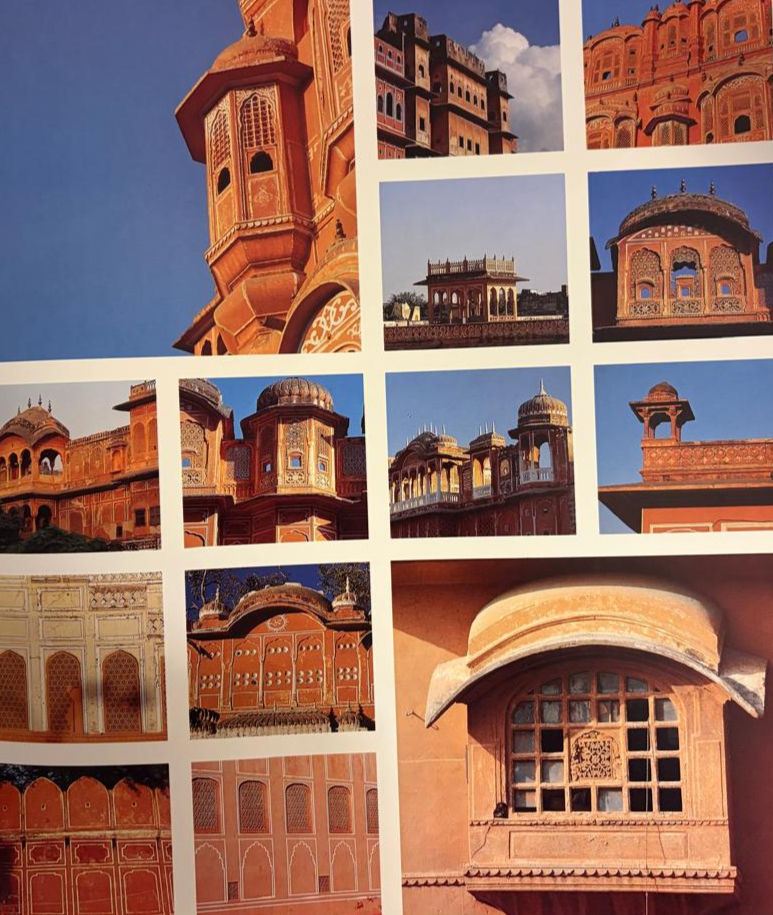
Once I had the form that I wanted, it was important to find the right colours. I knew a contrast would work best, the pink of the city against the blue of the sky was the idea. It needed something vibrant, something special. Fuchsia would be bold and draw attention to the print, and its wearer.
Every pattern that I design is a process, it moves through iterations of finalising the motif, placement, colour and contrast. Once I had chosen the colours, the Jaipur pattern came together quite seamlessly. The ikat is a derivation from Sarojini's paternal great-grandmother's saree. This is what my design practice is: contemporary patterns that take on their own visual and material languages, inspired by heirlooms and the built-environment.
Of course, designing a pattern is one thing, the next is to make sure that the clarity and depth of the print translates onto the fabric. When digitally Printing on pure silk, the colour and lustre come out almost identical to the way that they look on the drawing board. But it still requires some editing and working across a few different drafts before the print is finalised.
The final pattern is both vibrant and graphic, drawing on familiar motifs and reimagining them for a contemporary palette.

The Jaipur print is available in three styles of kaftans, and in a silk stole, silk-wool stole, and silk-wool shawl.

